Probably many of you have, by now, read Call the Midwife by Jennifer Worth, or seen the BBC series based on the book and two follow-ups. Those of you who have not have the most marvelous summer treat in store!
Worth (1935-2011) wrote her memoirs in her 60s, and the first volume was published in 2002. The BBC series began airing in early 2012.
The story is autobiographical, with most names changed to protect the privacy of people Worth hadn't kept in touch with in the 50 years since the story's setting. And that setting? It's Worth's foray into midwifery in the tough slums of London's East End in the 1950s and early 60s! Yes! This is Betty's world, replete with caps and cloaks, Cockney accents and bicycles.
The first book contains a lot less romance (the author fled a doomed love affair, in her mid-teens, to learn nursing in a West End hospital, and doesn't care to discuss it) and a whole lot more gynecological detail than a Betty novel. There are also heartbreaking stories of poor people abandoned to horror by a system without safety nets. Worth doesn't shrink from the sorrow and horror, but keeps a stiff upper lip and soldiers on, calling in the chiropodist to deal with toenails untrimmed for decades, befriending a young prostitute and trusting a mother of 25(!) to deal with a premature baby successfully. There's also a skinnydipping interlude in literal Brighton, but other than constant babies, no mention of metaphorical Brighton.
I've only seen two episodes of the show, one from the middle and one toward the end, but I get the impression romance figures more largely in the film version than the printed. And oh, the costumes! The hairdos! The meals!
Must dash to library and attempt to wrestle volumes two and three (Shadows of the Workhouse and Farewell to the East End) from what is most likely a long list of requestees. So maybe the bookstore...
Enjoy!
Showing posts with label life after Betty. Show all posts
Tuesday, July 1, 2014
Tuesday, July 17, 2012
Life After Betty
Life After Betty: The Uncommon Reader by Alan Bennett
Alan Bennett always makes me think of A Girl to Love, one of Betty Neels’s six stories to feature a
non-doctor in the role of hero/future husband.
In that one, Oliver Trentham is a wealthy, well-known writer for
television. That’s what Alan Bennett is! And he’s about the only writer for TV I could
name, and he was rather handsome as a youngster.
Bennett in 1973 – not bad for a
bisexual intellectual comedian who writes TV plays with Wittgenstein
references, right?
In addition to TV scripts, Bennett has also written a host of plays,
movie screenplays, essays, short stories and novellas. Apparently he acts, too, with a thick
Northern (Leeds) accent. The Uncommon Reader is one of the more
recent of the novellas, published in 2007.
At about 25,000 words, it’s a quick read, and with Bennett holding the
pen it’s a delightful and inspiring one that repays re-reading.
The central conceit of the story is that Queen Elizabeth II, stumbling
upon a mobile public library, picks up a novel to be polite and gets captivated
by the world of literature. Bennett
conjectures that the queen had previously not been a reader in part because of
the requirement attaching to her role that she avoid obvious preferences. “And besides, reading wasn’t doing. She was a doer.” On her first attempt, she inadvertently
chooses a “duff read,” but perseveres:
“That was the way one was brought up.
Books, bread and butter, mashed potato – one finishes what’s on one’s
plate.” To escape a dull meeting, she
takes out a second novel, and Nancy Mitchell’s The Pursuit of Love captures the queen.
She becomes a voracious reader with a catholic taste that encompasses
Jean Genet, Lauren Bacall and Alice Munro.
Staff and family are forced to make adjustments in schedules and
standard procedures to accommodate her majesty’s reading. Various functionaries try to curtail it, but
their efforts are powerless in the face of literature’s pull.
This imaginary queen makes important discoveries in her reading, both
as she thinks over what she’s read and as she moves on to writing down her
thoughts. “Briefing is terse, factual
and to the point. Reading is untidy,
discursive and perpetually inviting.
Briefing closes down a subject, reading opens it up.” “A book is a device to ignite the
imagination.” “You don’t put your life
into your books. You find it
there.” As she writes, she is liberated
to discover, for the first time, her own voice.
This is a wonderful, chatty little story with some great suggestions
for future reading, and some thought-provoking reflections on the causes and
effects of literature. The queen, as
Bennett imagines her, is a delight – smart, thoughtful, forthright. His suppositions seem so reasonable that I
have a hard time remembering this is a novel,
not a biography, and I still finish up with a strong affection for the real
queen, as it seems so possible she could
be just like the one in the book. And
then I read it again.
Brighton: not even vaguely
Clothes: the queen becomes very
slightly less attentive to her wardrobe as she reads more; “’I’d outlaw that
cardigan,’ said her maid.”
Food: boeuf en croute!, poires
belle Helene, a wicked trifle, etc.
Friday, March 2, 2012
Life After Betty: Miss Pettigrew Lives for a Day
With my apologies for not having finished a Betty by the Numbers for this week (we're having a party tonight!), I hope you'll seek out and immensely enjoy this wonderful happy-cupcake of a novel.
This is a wonderful book! I just discovered it a year or so ago, and have probably read it four times since. There’s also a very good, though very different, movie version. Big caveat: the stinkin’ book carries the 1930s English lit stain of anti-Semitism. Gosh, I hate that. But it’s in about two or three sentences, so I excise them mentally and carry on with the otherwise-most delightful Cinderella story ever.
Guinevere Pettigrew is an Araminta at forty-ish, complete with the mouse-colored hair, but without the advantages an RDD provides. She’s struggling to navigate London in the 1930s, and finding the going difficult for a dowdy spinster who’s not very good at her putative profession of governess-ing. (She finds children frightening.) A curate’s daughter, she was reared to strict standards of morality, humility and gentility. Add to that twenty years of living in other people’s homes, at the mercy of her employers’ moods, children and household rules, and she’s gone from timid to chronically terrified; from modest to apologetically subservient. Our story opens with Miss Pettigrew in desperate need of a job that will save her from the workhouse. In search of that job, she finds adventure, friends and happiness.
undated photo of residents of an English workhouse. They seem frequently to have been stuffed with children, which would have made them especially upsetting for Miss Pettigrew
An employement agency sends Miss P. to the home of Miss Delysia LaFosse (née Sarah Grubb), an actress and nightclub singer of surpassing beauty in need of a governess, despite that “Miss.” Miss LaFosse has a more immediate problem – too many gentlemen friends about to collide – and despite her parsonical upbringing and belief in her own incompetence, Miss P. makes great strides in sorting out the various callers to beneficial effect. Miss P. quickly realizes that life’s exigencies have made her much more open-minded and affectionate, and less sternly moral, than her parents and culture molded her to be.
Early in the day (sometime between 11:35am and 12:52pm; the chapters are titled according to the minutes they encapsulate), Miss P. decides “she was going to accept now everything that came along,” including a dry sherry. She is quickly swept into Miss LaFosse’s gay and frivolous life, teetering on the edge of debauchery, and experiencing all sorts of exciting things she’s never known before, including furs, taxis, a nightclub and kindness. Her quick wit and courage help her new friends out of several fixes, and she wins a beau of her own and a much, much better job than any she’s held before. Sometime around 4:00am, the novel closes with a delicious and well-earned sense of happy-ever-after-ness.
Miss Pettigrew and friends attend a cocktail party that may have been quite like this one shown in the TV show Upstairs, Downstairs
It’s not just the marvelous Cinderella story that makes Miss Pettigrew such fun. Listening in on Miss P.’s thoughts as she transforms herself from cringing, unloved drudge to brilliant social strategist and fierce guardian of her friends’ best interests is great fun – funny and uplifting. Early in the book, “Miss Pettigrew cast a sternly disapproving eye about her, but behind her disapproval stirred a strange sensation of excitement.” Close to the end, she’s thrown her upbringing to the wind: “If the small voice of conscience did pipe up, Miss Pettigrew turned a wickedly deaf ear. ... She was out to enjoy herself as she had never enjoyed herself before, and all the sermons in the world wouldn’t change her course. ... Now she lived. She was inside of things. Now she took part.”
I like the movie less well, but still recommend it. It makes two significant changes from the book: first, it feels truer to its time period – the late 30s – by bringing WW II’s imminence into the story. That helps put the gaiety of the society butterflies and Miss Pettigrew’s very different experience into a more realistic perspective. The second dramatic change is a lousy one: rather than show the camaraderie between women that the book emphasizes, the writer imbues one of the nicest secondary characters in the book with a vicious jealousy of Miss Pettigrew, and shows the two as rivals rather than supportive friends. Pfui.
Brighton: Miss La Fosse luxuriates in all the most garish parts of that sinful city; other characters visit; our heroine’s beau has clearly been there; our heroine, at 40, has never kissed a man. “’The culmination of all true romance,’ said Miss Pettigrew sternly, ‘is marriage. Unless the thought of marriage enters both partners’ heads, you may be sure there will be no permanent happiness.’”
Clothes: a five-year old coat of a nondescript, ugly brown, not thick enough for a cold, drizzly November day in London; a silk and lace négligé; real silk underclothes; home-made woolen underclothes; black velvet evening dress with jade earrings and necklace; a fur coat; a “magnificent black evening wrap with a white fox collar;” gentlemen in evening dress and more.
Food: not really a focus, but grapefruit, ham, eggs, toast and marmalade; various cocktails, including Miss P’s own pour of soda water with just a dash of sherry for color (“Why men waste money getting drunk on [whiskey], when they can get a really cheap palatable drink like lemon squash...!”); a nice cup of tea; a delicious dinner with unspecified soup, fish, roast and sweet; a “marvelous concoction” of “cream and fruit and nuts and ice-cream and a wonderful syrup.”
Incidentally, the author’s story is fascinating. She was a secretary with time on her hands, reading at work, when she remarked to her sister and brother-in-law that she could write a better book than the library’s latest offering. Her BIL told her to get on with it, and she wrote six novels, in three or four quite different styles, before giving up writing to run a household that included her husband, children and mother-in-law. “You can’t write if you are never alone,” Ms. Watson explained to an interviewer. Miss Pettigrew Lives for a Day is very available at my local library, and I would love to know what others (like you) think of it.
Thursday, February 9, 2012
Life After Betty
via email from Betty Barbara:
Nurse Nolan
by Susan Barrie copyright 1956 (original title: Dear Tiberius)
however--Nurse Nolan was already a Betty book in the making!
Look here:
Young, pretty English nurse(our Lucy) on private duty to look after the mother-less, wheel-chair bound daughter(Miranda) of cold, sarcastic English shipping magnate (Sir John Ash), who, in turn, is very interested in ballet star(Lynette Harling). Enter the handsome, personable, eminent Austrian surgeon (Rupprecht Wern) who shall try to get young Miranda on her feet again.
So, we have our Lucy--torn between two men--what’s not to like?
Well, fellow Bettys--
This may sound like a possible Betty book--but it is not. Sigh.
I found it almost unreadable; all due to the author’s convoluted prose. Why use 3 words when 13 will get the job done? But somewhere, in the midst of all that verbiage is a good story. Let’s dig and see what we can find:
Sir John Ash, cold, sneers a lot. Not too tall, slender (!!),dark haired workaholic. Condescends to come from London once a month to visit Miranda and verbally fence with Nurse Nolan. He is currently escorting Miss Lynette Harling. It is rumored that he is thinking of marrying her.

Very hard to do this when you have a sprained ankle.
Miranda, supposedly 12 but really acts and sounds no older than 8, was injured several months earlier in an accident while on a school trip. She is slowly wasting away in her wheelchair. But wait! All is not hopeless. Eminent Austrian surgeon Ruppercht Wern believes he can operate and have her on her feet again. That is, if the operation doesn’t kill her!
And our heroine, Lucy Nolan. Young, slender, pretty (with long, dark curling lashes) is fiercely protective of Miranda. She starts off hating Sir John, but gradually comes to understand him and falls in love with him. This love enables her to withstand the charms of Dr Wern (who is a Much Nicer Person that Sir John).
{Any Betty who honestly thinks that Lucy will end up with the doctor needs to report to the office for a refresher course in Harlequin Romance}.
Lucy and her sister see Sir John and Lynette at the theatre. This is Lucy’s first sighting of Miss Harling and the sister’s first look at Sir John. Watch Sir John react to seeing Lucy out of uniform.

Just a little something in blue that Lucy borrowed from her sister
Watch Lucy refrain (heroically) from stabbing her sister for engineering an encounter.
Ah, the requisite week long house party. Sir John invites Lynette, her faithful male friend(!) and her mother for a nice, relaxing time at Ketterings, Sir John’s non-ancestral home :
Just a modest little place in the country.
(Yes, my Bettys, he bought it lock, stock and faithful retainers). Everyone lounges about chicly clad. Well, actually Lynette’s mum is a very nice Cockney lady who spends most of her time knitting very ugly sweaters and Francis Burke (the male friend) mopes around watching Lynette with puppy-dog eyes, but still…you get the idea.
Lynette arrives for a week in the country:
This is not a good week for Lucy. Sir John puts her at Lynette’s beck and call. Watch Lucy seethe while giving Lynette a massage. Watch Lucy seethe even more when Lynette(clad in a nightgown and dressing gown to die for) flaunts a great honking diamond ring and insinuates that it is an engagement ring.
Enter Dr Rupprecht Wern. He has come to Ketterings to examine Miranda, to see if he can do anything for her. He believes he can. Miranda is very excited. She sees it as a simple three step program; fly to Vienna, have surgery, walk again. However, Sir John gets the unvarnished version, which he shares with Lucy. But he decides to okay the operation.
a well known clinic in Austria
Where’s Sir John? Back in London--’call me if you need me’, he says. Sheesh! But he does show up right before the operation, stays long enough to find out it’s a success and then goes away again.
...modest lodge run by Dr Wern’s mother and sisters...
as Miranda recuperates and does her physical therapy. Dr Wern teaches Lucy to ski! Fun is had by all. It is obvious that good ole’ Rupprecht has fallen for our Lucy. Sir John reappears and poor Lucy is an emotional basket case. Watch Sir John become very jealous! However, not to worry, we are soon treated to Sir John denying he is engaged, Lucy falling over in surprise (they are on the ski slope) and twisting her ankle and ta-dah! Sir John proposing to Lucy. Yay!!! Everyone is happy, except Rupprecht, of course. But don’t worry about Rupprecht. Miranda has decided she will marry him when she gets old enough.
THE END
I rate it a Treacle Tart with some vanilla ice cream on the top. That’s for the story. The actually writing style of the author is down around Beans on Toast.
A couple of notes of interest for my fellow Bettys.
There are no food descriptions--none! Susan Barrie was not a foodie like the Great Betty. Lots of spiffy clothes, including a red dress for Lucy, but no food.
We never learn where Sir John lives in London. Never. So there are no Dobbs and Mrs Dobbs or the like. When Lucy and Miranda come to London before flying to Vienna they stay with Lucy’s sister! Sir John doesn’t even put them up at Claridge’s!
Sir John has a socking great Bentley, but it is usually driven by the chauffeur. There is only one scene where Sir John actually drives the Bentley himself.
But he does drive very well.
And the ring that Lynette flashed around the last time we saw her? Well, yes, Sir John gave it to her, but never as an engagement ring.
(The ring was one of his mother’s--Lynette saw it, liked it, he gave it to her. Which brings up the question of why he was showing her his mother’s jewel chest in the first place…..)
Wednesday, February 1, 2012
Life After Betty: Elinor Lipman
Brighton alert! Most of Elinor
Lipman’s heroines and heroes are perfectly comfortable in Brighton, though it’s
much more the mid-priced B&Bs in quiet side streets than the garish, flashy,
big hotels by the boardwalk, and they don’t describe their visits. You’re welcome to blame them if you like, but
since they are largely college-educated New Englanders in the 80s, 90s and 00s
in long-term relationships that may or do lead to marriage, their fictional
behavior is much more plausible than not – in real life, those folks are highly
likely to make the trip.
And realistic is something Lipman does extremely well. Her secondary characters are often colorful –
a radio personality, an accused murderer, a delusional, aging dancer – but her
heroes and heroines are more like the folks you probably know: a medical intern, a hotel manager, a police
officer, a temp/aspiring writer. When
the colorful carom into the not-so-much, the results are humor, self-discovery
and romance.
Elinor Lipman’s first novel takes
an ordinary woman, an ordinary man, a flamboyant birth mother and an unusual
situation and gets emotional growth and happy-ever-after from the mix.
Her first full-length novel was Then
She Found Me, which got turned into a movie with Bette Midler and Helen
Hunt with only the vaguest similarity to the novel. The book features April, a 30-something
teacher, and Dwight, the 30-something librarian she’s always found dorky. April has adjusted to the deaths, a few years
before, of her adoptive parents, when suddenly her birth mother appears in her
life. Bernice is a glamorous, self-aggrandizing
liar and demi-celebrity on local TV, and she desperately wants April’s
acknowledgement, affection and respect.
Deflecting Bernice’s emotional assaults leads April to Dwight, and she
gradually revises her opinion of him, resulting in as H an EA as real lives
offer – which is to say, quite happy.
Dwight and April’s relationship is a revealing sub-plot in a story more
deeply concerned with the conflicted, complicated relationship developing
between Bernice and April. The
mother-daughter relationship is strained by April’s surprise, her loyalty to
and love for the parents who reared her, and Bernice’s egotism and persistent
dishonesty. She’s no one’s idea of a
Weeping Despot, but she certainly tries to ride roughshod over April’s lower-key
character, demanding rather than earning a connection. Our heroine and her sidekick don’t give in –
often – and together they manage the emergence of a new family with care and
humor. Bernice has moments of
sensitivity, but for the most part I find her a singularly unsympathetic
character. I am sometimes frustrated by
April’s tolerance of her birth mother’s worst moments, but that frustration
forces me to stop and think a bit more about why April puts up with Bernice’s
emotional greed and flamboyant pushiness.
The love story is really lovely.
I empathize deeply with these two people’s attraction to each other, and
absolutely believe in April’s slowly-dawning awareness of that attraction. “He stood up slowly, threw his balled-up
lunch bag neatly across the room into the open barrel. The grace of his set shot surprised me. He smiled down at me and said, ‘Liar.’ I watched him collect the rest of his trash
and reassemble the thermos; he took my coffee cup and swallowed the rest like a
belt of scotch. The huge Adam’s apple
dipped; below it, his blue pinstripe shirt was unbuttoned at the neck. A few chest hairs poked through a small hole
in his T-shirt. I felt a sudden pull in
my gut for no reason.”
Lipman is a wonderful writer.
Her heroes and heroines are hugely likeable, and her prose is
restrained, clear and vivid. She is a
member of the New England academic/artistic community, and knows that
environment cold and describes it accurately and affectionately, without
sentimentalizing (mostly). All of her books
touch that world to some degree, and if you like Then She Found Me, you’ll almost certainly enjoy The Inn at Lake Devine, The Way Men Act, The Dearly Departed, and The
Pursuit of Alice Thrift. Secondary
characters Isabel of Isabel’s Bed and
the delusional dancer of My Latest
Grievance are especially colorful, notably in their approaches to marriage
and non-marriage, so if you’re Brighton-sensitive, approach cautiously. Your library probably has many of these.
Caveats: dialogue includes
swearing, and the secondary characters have a much more cavalier attitude
toward Brighton than heroes and heroines.
The book is set in the 80s (published in 1990), and Bernice smokes quite
a bit – in restaurants, which on my 2012 re-read I found oddly disconcerting,
though realistic. Also, these characters eat a lot of Chinese food.
Salman Rushdie plays the ob/gyn
in the movie version. The novel does not
have an ob/gyn character, since no one has need of one in the course of the
story. Further, the hero of the novel
doesn’t appear in the film, and the unmarried heroine of the book is going
through a divorce in the movie. I
haven’t seen the film, but it has both Bette Midler and Colin Firth. Hmm.
Saturday, December 10, 2011
Life After Betty
We have been loving all the new Life After Betty suggestions here at TUJD (I have been adding to my Amazon wish list - just in time for Christmas!) . This jewel won't be going on my wish list - it's free. You heard me. Free.
-Betty Debbie
via email from Betty Beth:
Hello, Founding Bettys!
While I am still in the midst of writing my Betty Neels homage of a NaNoWriMo (I reached 50K and it's not done yet; how did that happen?!), I'm loving the Life After Betty books that are popping up. Between them and all the unread Neels that I haven't devoured yet, my to-read list is getting longer! Hopefully I can make some headway on it during the holiday season!
I wanted to offer a suggestion for Life After Betty, if that's allowed. The wonderful review of I Conquer the Castle reminded me of one of my favorite books of all time... The Blue Castle by L.M. Montgomery of Anne of Green Gables fame.
Unlike every other book L.M. Montgomery wrote, this book is not set on Prince Edward Island! But the beautiful scenery more than makes up for it - it's set in a fictional village in Ontario, Canada, sometime in the first half of the 1920s. Woods and lakes and flowers are, of course, lavishly described by the nature-loving Montgomery, and it's full of fun, small-village characters and gossip.
Our heroine is Valancy Stirling: twenty-nine, plain, unmarried, and completely run down by her family's insistence that she is dull and prone to illness. A true Betty heroine! She does her best to escape her petty mother and aunt by reading nature novels and building a fantastic "blue castle" in her mind where she is always welcome and can do whatever she wants.
When she is diagnosed with a heart problem, there is no dashing Dutch doctor to swoop in and save her, so Valancy decides she's at least going to do what she wants and be happy - two things her family have never allowed! Between talking back, saying precisely what she thinks (even to the rich uncle who the entire family treats deferentially in hopes of inheriting his wealth), and disregarding all orders to the contrary, Valancy discovers that she likes being happy, and decides she'll spend what time she has left on this earth doing whatever she wants.
This, of course, leads her entire staid and rather stuffy small-town family to think she's gone mad, and Valancy doesn't help matters by leaving home to nurse the dying Cissy Gay, outcast for having a baby out of wedlock. Cissy's father, the town drunk Roaring Abel, is hilariously up-front and only encourages Valancy to do what she wants. So she spends her time caring for Cissy as best she can in their lovely little cottage, and meets the mysterious Barney Snaith. The villagers don't like him much - rumors have him as a dangerous criminal or the father of Cissy's deceased child - but he treats Cissy and Valancy well and doesn't ostracize Roaring Abel for his drinking. So when Cissy dies and Valancy's family order her back home to put her wild ways behind her, Valancy does nothing of the sort.
Instead, she proposes to Barney. She only has about a year left to live, she explains, and while she's in love with him, she doesn't expect him to fall in love with her right back. (Sound familiar?) Barney accepts, and they're off and married before anyone else can have a word in edgewise. Barney lives on a little island in the middle of the lake, and Valancy moves out to it with him... only to be told that on no account is she to go into the mysterious "Bluebeard's chamber" where he disappears to work...
It's a brilliantly written novel, and you can't help but feel sympathetic to Valancy throughout everything. It's also a lovely slice-of-life work for the 1920's, full of little things that bring the period alive and make me smile (the price of gas, in particular...). There are mistaken identities (more than one!), gossipy villagers, eccentric uncles, secretly concerned aunts, vividly painted rooms and furniture that you can practically see, devoted family cats, heaps of nature scenes (it is L.M. Montgomery...) and a beautifully improbable resolution that is immensely satisfying.
Clothes: a despised flannel petticoat, an equally despised brown silk dress with a high collar and long sleeves, and after her "liberation", "She got a pretty green crepe dress with a girdle of crimson beads, at a bargain sale, a pair of silk stockings, to match, and a little crinkled green hat with a crimson rose on it. She even bought a foolish little beribboned and belaced nightgown." Plus a "little smoke-blue chiffon", a green bathing suit, a pearl bead necklace, and a life-altering pair of high-heeled leather shoes.
...And the food might not be up to Neels's standards, but oh, the names for the cars! "Tin Lizzies" and the "Lady Jane"!
It's one of my absolute favorite books to curl up with when I need to read a story about an unhappy woman's life turning around into perfection. And the best part of all is that it's online free to read! The Australian Project Gutenburg has the whole novel online, at http://gutenberg.net.au/ebooks02/0200951h.html. So if you can't find it at your local library and are snowed in on a cold evening with just beans and toast, click your way over and enjoy the escapism into 1920s Canada!
-Betty Beth
-Betty Debbie
via email from Betty Beth:
Hello, Founding Bettys!
While I am still in the midst of writing my Betty Neels homage of a NaNoWriMo (I reached 50K and it's not done yet; how did that happen?!), I'm loving the Life After Betty books that are popping up. Between them and all the unread Neels that I haven't devoured yet, my to-read list is getting longer! Hopefully I can make some headway on it during the holiday season!
I wanted to offer a suggestion for Life After Betty, if that's allowed. The wonderful review of I Conquer the Castle reminded me of one of my favorite books of all time... The Blue Castle by L.M. Montgomery of Anne of Green Gables fame.
Our heroine is Valancy Stirling: twenty-nine, plain, unmarried, and completely run down by her family's insistence that she is dull and prone to illness. A true Betty heroine! She does her best to escape her petty mother and aunt by reading nature novels and building a fantastic "blue castle" in her mind where she is always welcome and can do whatever she wants.
When she is diagnosed with a heart problem, there is no dashing Dutch doctor to swoop in and save her, so Valancy decides she's at least going to do what she wants and be happy - two things her family have never allowed! Between talking back, saying precisely what she thinks (even to the rich uncle who the entire family treats deferentially in hopes of inheriting his wealth), and disregarding all orders to the contrary, Valancy discovers that she likes being happy, and decides she'll spend what time she has left on this earth doing whatever she wants.
This, of course, leads her entire staid and rather stuffy small-town family to think she's gone mad, and Valancy doesn't help matters by leaving home to nurse the dying Cissy Gay, outcast for having a baby out of wedlock. Cissy's father, the town drunk Roaring Abel, is hilariously up-front and only encourages Valancy to do what she wants. So she spends her time caring for Cissy as best she can in their lovely little cottage, and meets the mysterious Barney Snaith. The villagers don't like him much - rumors have him as a dangerous criminal or the father of Cissy's deceased child - but he treats Cissy and Valancy well and doesn't ostracize Roaring Abel for his drinking. So when Cissy dies and Valancy's family order her back home to put her wild ways behind her, Valancy does nothing of the sort.
Instead, she proposes to Barney. She only has about a year left to live, she explains, and while she's in love with him, she doesn't expect him to fall in love with her right back. (Sound familiar?) Barney accepts, and they're off and married before anyone else can have a word in edgewise. Barney lives on a little island in the middle of the lake, and Valancy moves out to it with him... only to be told that on no account is she to go into the mysterious "Bluebeard's chamber" where he disappears to work...
It's a brilliantly written novel, and you can't help but feel sympathetic to Valancy throughout everything. It's also a lovely slice-of-life work for the 1920's, full of little things that bring the period alive and make me smile (the price of gas, in particular...). There are mistaken identities (more than one!), gossipy villagers, eccentric uncles, secretly concerned aunts, vividly painted rooms and furniture that you can practically see, devoted family cats, heaps of nature scenes (it is L.M. Montgomery...) and a beautifully improbable resolution that is immensely satisfying.
Clothes: a despised flannel petticoat, an equally despised brown silk dress with a high collar and long sleeves, and after her "liberation", "She got a pretty green crepe dress with a girdle of crimson beads, at a bargain sale, a pair of silk stockings, to match, and a little crinkled green hat with a crimson rose on it. She even bought a foolish little beribboned and belaced nightgown." Plus a "little smoke-blue chiffon", a green bathing suit, a pearl bead necklace, and a life-altering pair of high-heeled leather shoes.
...And the food might not be up to Neels's standards, but oh, the names for the cars! "Tin Lizzies" and the "Lady Jane"!
It's one of my absolute favorite books to curl up with when I need to read a story about an unhappy woman's life turning around into perfection. And the best part of all is that it's online free to read! The Australian Project Gutenburg has the whole novel online, at http://gutenberg.net.au/ebooks02/0200951h.html. So if you can't find it at your local library and are snowed in on a cold evening with just beans and toast, click your way over and enjoy the escapism into 1920s Canada!
-Betty Beth
Friday, December 9, 2011
Life After Betty
via email from Betty van den Betsy:
Life After Betty – Dodie Smith
Dodie Smith (1896-1990), a prolific playwright and novelist in the mid-twentieth century, today is best known for her children’s book The Hundred and One Dalmatians. You should read that, and The Starlight Barking, its sequel, even if you’re a grown-up, because they are delightful and scary and vividly evocative of the setting. That their setting is upper-middle class life in mid-century London and rural England, albeit from the perspective of some very anthropomorphic dogs, is a bonus.
However, her best-known novel for adults, I Capture the Castle, may be of more immediate interest for fans of Betty Neels. The narrator, Cassandra Mortmain, is almost 18 and captured by family circumstances in a crumbling 17th-century house grafted to a 14th-century castle. She has literary aspirations, and as an exercise in learning to write, she begins a journal – with the sentence, “I write this sitting in the kitchen sink.”
Mortmain family life is as quirky as Cassandra’s writing perch. The family has “been poor for five years now,” living on what they can get from their garden, sales of the good furniture and the small royalties still coming in from a very important work of literature Cassandra’s father wrote about 15 years earlier, before the first world war. Since then, he has been jailed briefly for a minor dust-up with a neighbor, has moved his wife and three children to the Sussex castle/house of the title, and remarried, following his wife’s death, an exotically-lovely artist’s model named Topaz. Most urgently, though, he has stopped writing, which means the family finances have suffered, to the point of near-catastrophe.
Cassandra has begun her journal at a fortuitous moment, though; the family fortunes are about to change. While she finds her situation, viewed from the outside perspective of the sink, at least potentially romantic, her older sister, Rose, is disgruntled, inclined to bitterness, and desperate enough to wish on the gargoyle that juts from the castle wall into the family kitchen. Her wish seems to produce results when two American brothers, the elder heir to a local manor house, stumble upon the Mortmains.
Simon and Neil Cotton arrive at the castle one night in a downpour that carries the first scent of spring, while Cassandra is in the tin bath by the fire, protected by just-dyed sheets hung to dry around her, Topaz is walking about the ancient tower mound wearing nothing but Wellington boots, and Rose is modeling a romantically-lovely tea gown with Medieval sleeves. They are captivated by the family’s unusual situation, and their interest is reinforced by Simon’s appreciation of James Mortmain’s famous book. However, the initial relationship is rocky, and it takes a dramatic situation to resolve early misunderstandings.
As the families get to know each other better, a love pentagon – or maybe even hexagon – develops, while Cassandra and others worry about James Mortmain’s increasing eccentricity, and try to channel his renewed intellectual energy into writing. Cassandra, suffering the first pangs of infatuation, love and desire, takes counsel from the wise village vicar as well as from family, other friends, her favorite authors and her daydreams. Since the novel is in the form of a journal, written journalistically as events happen, the reader must puzzle out the connections and conclusions along with the narrator. That process strengthens the realistic tone of the story.
The book’s sweep is ambitious. Cassandra considers love, literature, family, duty, faith and art as grand questions as well as daily realities. The book’s setting is comfortable: even in the face of poverty and emotional distress, the reader feels confident Cassandra will win through – if not to a traditional happy ending, at least to a better sense of herself and her abilities, and continued interest and excitement in life’s possibilities.
Dodie Smith writes vividly. The reader hears the rain she describes, feels the joy of eggs for tea, and smells the bluebells blossoming in the woods. Her characters are genuinely likeable and surprisingly realistic for so romantic a group. The main characters, Cassandra and Rose, are supported by an assortment of colorful, complex and fully-fleshed secondary characters. Cassandra sets out to “capture” the castle and its inhabitants, and the book succeeds at painting a rich and evocative portrait of some unique and admirable individuals at a point of transition and growth. Perhaps one of the loveliest lines in this consistent lovely story comes at the close of the first chapter: “I think it worthy of note that I never felt happier in my life – despite sorrow for father, pity for Rose, embarrassment about Stephen’s poetry and no justification for hope as regards our family’s general outlook. Perhaps it is because I have satisfied my creative urge; or it may be due to the thought of eggs for tea.”
Clothes: a dyed-greenish tea gown (“As if anyone ever wore a tea gown for tea!”), old white suits, a bear-fur coachman’s coat, a pink muslin dinner frock worn over a crinoline, an outgrown schoolgirl’s swimsuit and schoolboy swim trunks (“they were helping to stop up Thomas’s draughty chimney; luckily they are black”), a fashionably-black evening dress worn with shoes that keep slipping off, and much, much more.
Food: bread and margarine and boiled eggs for high tea, and on another, better occasion new bread, real butter and honey (“I shouldn’t think even millionaires could eat anything nicer”); oatcake with margarine and sugar in lieu of a biscuit; cocoa; a chocolate bar to eat in the bath; roast chicken with bread sauce, two veg and treacle pudding; real champagne at a dinner party where Cassandra realizes “you can’t notice food fully when you are being polite,;” steak cooked over a fire (“this is called a ‘barbecue’”); cherry brandy: marvelous jellied soup; and, yes, more – much, much more.
Wednesday, August 10, 2011
Life After Betty
via email from Betty Barbara:
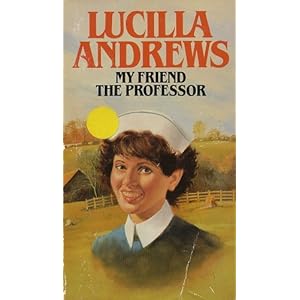
My Friend the Professor by Lucilla Andrews c 1960
171 pages of tiny type.

Yes, that’s the copy I read, published 1967 . (Betty Debbie here - sorry, I couldn't open the picture she sent - I'm visiting Betty Keira this week and don't have my 'tech support' here...he had to stay home - I substituted this less than awesome picture from Amazon.com).
Before we begin:
How to tell you are not reading a book by Betty Neels:
The book is told in first person, from the point of Frances Dorland, our nominal heroine.
There are almost no clothing descriptions.
There is no food. Wait, that’s not quite true. There are no glowing descriptions of food. I vaguely remember sandwiches being mentioned.
There is no Veronica.
There is no socking great Bentley.
There are no critters: no dogs, no cats
There are no Jollys
On to the story:
Our tale opens with the introduction of Frances Dorland, 19, on her way to start her nurse’s training at Martha’s Hospital. Well, actually at the training school that’s attached to the Hospital’s country annexe. Our Frances is no raving beauty, but fairly attractive and has great legs. We learn that Frances is no contender for the Gold Medal(like dear Rose Comely). She can be a bit dense, but she has a good heart.
Several other young ladies are also introduced:
Hannah More, who has her children’s qualification, but wants more. She exists(plot wise) as a way to introduce her personable medical student cousin Bart More.
Estelle Dexter, also 19, who is a newbie like Frances. Estelle is blonde, chic, the granddaughter (and sole heir) of Sir Hamilton Dexter. She has her own car and wears Dior when she‘s not wearing a uniform. As we go along we learn that she’s shy and smart. We like Estelle.
Preliminary Training School
P.T.S. is really Boot Camp. There’s the Sister in charge, who looks like an old battleaxe and her #2, Staff Nurse Nayler, who is always smiling. The girls quickly learn that Nayler’s smiles meant “only that she was showing her very good teeth”. Nurse Nayler is the villain of the PTS episode.
At PTS, the girls learn to make beds(the Martha’s way), wrap bandages, give injections, cook egg custard and make linseed poultices. They also learn basic anatomy-names and locations of bones, muscles and so on.
Late one Saturday afternoon Frances heads up the hill behind the campus. It starts with the thunder and lightening show and our Frances(who, very Neels like, hates storms) barely makes it to the top of the hill and the small shelter before it becomes really nasty.
And Lo and Behold the shelter is already occupied by the man we come to know as The Professor. Frances describes him as tall(check), thin(what?), of her parents’ generation(oh no!). While waiting out the storm they do the idle chit-chat thing, without exchanging names. He (and his binoculars) reveal that he’s a birdwatcher. She reveals that her father is a Turkey Farmer(!!!), gets hints on how not to curdle her egg custard. As often happens in these kind of conversations, she tells him more than she thinks she does.
While Frances is on the hillside meeting The Prof, Hannah and Estelle are in the village closest to the PTS, meeting Bart. Bart is a medical student at Martha’s, currently assigned to the country annexe. He’s about 25 and cute. Could Estelle be smitten?
Confidences are exchanged that evening. The girls speculate like crazy about who The Professor could be.
Estelle: “Are you positive he wasn’t one of our men?”
Frances: “If I thought I had unburdened myself to a senior member of Martha’s I’d walk our here and now.” And besides, she adds, “he’s not my type.”
Okay--it is obvious that what we have here is the first big hint and the first ‘famous last words’.
The Letters
She gets a letter from him (big surprise--how did he know her name?), with an exclusive London Club as a return address and a signature that says he’s J.S.Slane. Very impersonal letter--here’s some bird pictures. Frances answers with an equally impersonal-do you know anything about linseed poultices. And thus a correspondence begins. He writes one week, she answers the next and so on. Frances stars looking forward to the letters and daydreaming about the Prof (though she invests him with a Mrs. Prof and a number of little Profs.). Somewhere over this time he goes from being a lot older to “not very much” older. In other words, our Frances is building castles in the sand. The daydreaming gets Frances in trouble with Sister Tutor. Her neck is saved by info from her ‘homework hotline’ aka The Prof. who gets the answer for her with some help from a pathologist he knows(Hint, hint)
The Waters Are Muddied
Bart comes up to the school to visit Hannah, Estelle and meets Frances. Hannah thinks that Bart and Frances should get together, but Bart seems more interested in Estelle (who is doing her best to ignore him).
London Here We Come
Our intrepid trio has successfully graduated from PTS and are now assigned to Martha’s in London. It appears to be situated on the river. It is an old hospital with a new wing under construction. It has NO air conditioning.
Frances and Estelle’s first assignment is Josephine Ward, or Women’s Medical. As student nurses, they catch all the grunt work, like cleaning bed pans and arranging flowers (what?). Frances develops a nice relationship with several of the long-term patients, especially young Lily Ellis. Bart starts spending a lot of time in Josephine Ward. Frances treats him like a brother, Estelle keeps giving him the cold shoulder.
The Fateful Trip to the Path Lab, part one
The Path Lab is the domain of the reclusive Dr Sir Marcus Eversley. He’s smart, he’s really rich, he’s a Baronet, he comes just this side of walking on water, he’s a bachelor, and appears to be married to the job. He does not show up in the gossip columns. He is not to be bothered by mere student nurses.
One fine day Frances is sent off to the Path lab to deliver a blood sample, stat! Of course our Frances gets lost on the way but finally makes it and delivers it into the hands of the man in the director’s office. He’s bald, plump, absentmindedly friendly. Frances believes she has met the elusive Sir Marcus. But the clever Bettys among us have our doubts, don’t we ladies?
Frances is definitely developing a one-track mind where the Prof his concerned, spending way too much time daydreaming about him and mooning over his letters. And then she gets The Phone Call of Shock. It’s the Prof, calling to tell her he’s met her parents, had a nice chat about bird watching with her father. He makes meeting them sound so natural and logical. She finally gets up enough nerve to ask him what he does and he vaguely replies that he’s “one of the many variant types of Civil Servants” and then complains about the paperwork.
Frances goes home on one of her days off, to consult with Mum. Alas, her timing is bad and her parents are busy de-beaking the turkeys. (No, I didn’t look it up. I didn’t want to know). So no help from Mum.
Back in Josephine Ward, young Mrs Lily Ellis dies, late one night, with Frances at her side. Frances is shook up(her first patient death), and goes seeking some fresh air and a place to cry in private. And runs into the Prof on an outside staircase (a short cut from the car park). He whisks her away for a drive. (No we don’t learn what kind of car he drives). He feeds her sandwiches (found in a pocket of his mac), chocolate and whisky. Gotta love a man who keeps chocolate bars and a flask of whisky in his glove compartment. Frances sobs (but not on his shoulder) and mops up with one of his hankies. He returns her to the Nurses’ Home All seems well.
The Waters Are Further Muddied
Bart and Frances run into each other on an afternoon off and spend some time sitting on a park bench, feeding the ducks (or is it pigeons or squirrels--never mind). The air is cleared. Frances says she can see he’s interested in Estelle, so why isn’t he pushing it? Bart does the whole “woe is me, I’m poor. What do I have to offer the granddaughter of the richest man in England?” and so on and so forth. As they’re sitting there, heads together, Bart notices Sir Marcus walking by, but Frances doesn’t seen him.
It’s time to switch assignments:
Frances is now in Out Patients and encounters the hostility of one Nurse Vickers. What is up with that?
Frances has an afternoon off and heads out to sit on the terrace. When who should appear but the Prof!! Where did he spring from? He offers another packet of sandwiches. They should have been his lunch, but he forgot to eat. Frances reads him the riot act over living on coffee and tobacco. Mrs. Prof should take better care of him. Hmmmm, there is no Mrs Prof. During the chat Frances mentions that she had met Sir Marcus. Did the Prof perhaps know him? Funny, the Prof spends a lot of time fiddling with his pipe and not looking at Frances. Frances then asks his advice (now he’s Dear Abby) on how to help Bart and Estelle, but she fails to mention Estelle’s name. At the end of that conversation, the Prof says “good-bye” and makes it sound final, puzzling Frances no end.
And then, no more letters, no more phone calls.
Two months pass in one sentence
(Picture pages being torn from a daily calendar and floating off like blown leaves).
Crisis
Scarlet fever outbreak among the nurses and Estelle falls seriously ill. She might not make it. She’s moved from Martha’s to another hospital that specializes in fever cases.
In the midst of this crisis there’s a phone call from the Prof. He’s just making sure she’s okay. Frances can’t really worry about the Prof right now, she’s too busy kicking Bart out of his despair by telling him that Estelle loves him! And he needs to let Estelle (sick though she is)know how much he loves her. Write her a letter, you dolt!
Ahhh, Estelle survives (did we doubt it?), thanks to modern miracle drugs.
The Fateful Trip to the Path Lab, part two
Frances, now working nights in Men’s Surgical, is sent up to the Path lab with a blood sample for Sir Marcus. She is to give it to him and come right back. She knows where is office is, knocks on his door, walks in and sees (drum roll) The Prof!! Surprise, surprise. She has no time to stick around for explanations.
Frances has a good deal of time to try and figure out why he hid his identity from her. All those snide “teacher’s pet” sort of comments now make sense. He doesn’t try to see her, merely writes her a nice letter of apology.
Back to the Beginning
Frances is loaned to the country annexe. And on her day off climbs the hill to the shelter where the Prof is waiting for her. The Great Misunderstanding about Bart is finally cleared up. The Great Deception is discussed. The air is cleared. She declares that he’s not too old (42); he decides that she’s not too young(19). “I love you”s are exchanged.
Big kisses. The end.
Thoughts from Betty Barbara:
I never really bought the romance between Sir Marcus and Frances. He is obviously smitten by the fresh, young woman he meets on the hill. He goes to a lot of trouble to learn her name, engineer a meeting with her family and so on. And (or is it ‘But’), he never lets his interest show . His letters are always impersonal as are his phone calls.
So this brings us to Frances. She builds this vast romance in her head from the flimsiest of evidence. When the letters and phone calls stop she isn’t really surprised--she always figured he would lose interest in her someday. Her feelings always struck me as more schoolgirl crush than true love.
They have only a handful of face to face meetings in the whole book, and an equally small number of phone calls. We never get a glimpse of what was said in the letters. but we are given to understand that the contents are innocuous.
I was never given enough evidence to let me believe that grand finale.
All of the emotional oomph of the book goes to Bart and Estelle. They have the believable romance and get the happy ending that they deserve. Thank goodness for Bart and Estelle.
This book shows its age much more than the Betty’s do. The medical practices and day to day hospital life are detailed more than in the Neels books. We get pages of how awful it is in the non-air-conditioned wards, for example. And all that detail ties the story to the date it was written.
I’d give this a Treacle Tart or maybe, Mince Pies.
For my fellow Bettys:
If, after all this, you are interested in reading this book I will gladly mail you my copy, no charge.
Warning: This copy is yellow and brittle with age. The cover is held on with strapping tape, The glue is failing and the last pages have come loose. Thus the rubber band to make sure that no pages get lost.
Subscribe to:
Posts (Atom)